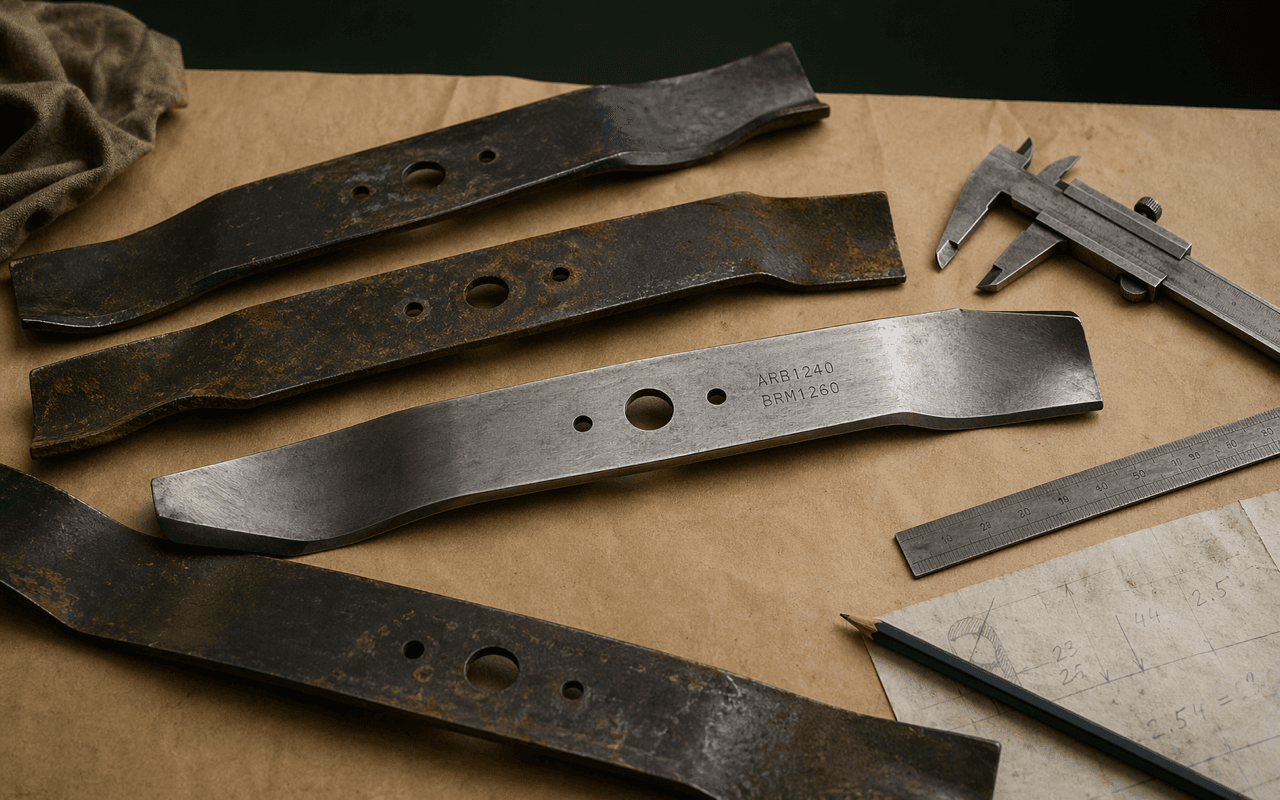
Start with the blade you already have
The strongest fitment signal is usually not the mower deck width, a store filter, or a vague memory of what the old listing said. It is the old blade itself. Brush off the grass, wipe the face near the center hole, and read the stamp before you read the packaging headline.
That old steel usually tells you four things at once: machine family, blade profile, mounting pattern, and nominal length. Buyers get into trouble when they read only the biggest number in the sequence and ignore everything else around it.
The stamp is a compressed sentence
On many homeowner blades the code is terse because the steel has no room for marketing language. A compact mark like an AR or BR family code is trying to communicate which deck family it belongs to, what kind of lift profile it uses, and what physical mounting geometry it expects.
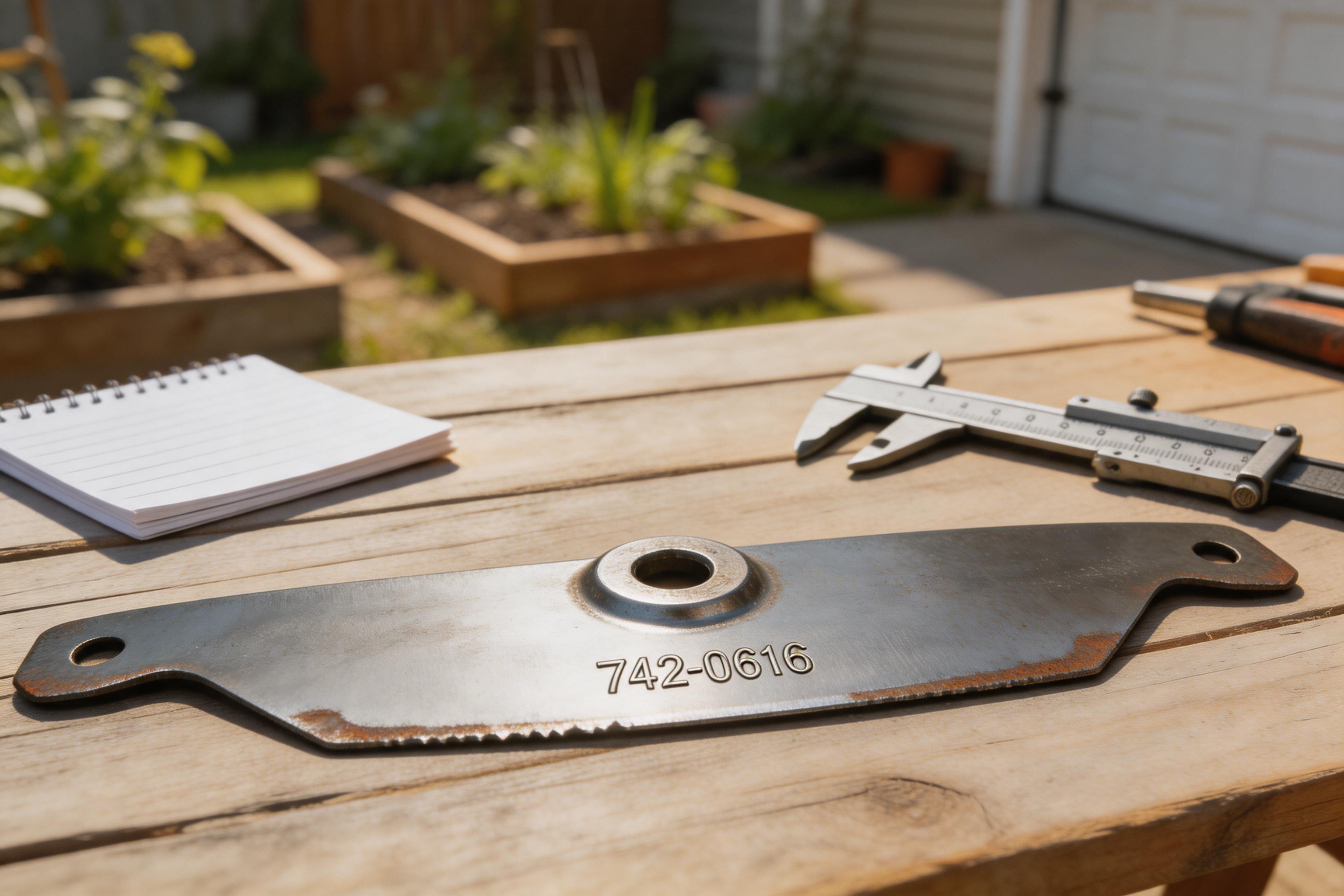
The bench photo above is the right workflow: identify the stamp, then verify it with measurements instead of trusting the stamp blindly.
The measurements that overrule the stamp
Even a legible part code should be checked against the hard dimensions:
- Tip-to-tip length.
- Stock thickness.
- Center-bore diameter or shape.
- Outer-hole or star-pattern alignment.
- Sail height and lift profile.
If one of those numbers disagrees with the replacement listing, stop there. A blade can be close enough to fool a quick visual check and still be wrong enough to cut badly or vibrate the deck.
Why deck width is weak evidence
A forty-two-inch deck does not uniquely identify a blade. Different decks with the same advertised width can use different blade counts, overlap strategies, bore shapes, or lift profiles. Deck width describes the machine's ambition. The blade stamp and dimensions describe the steel the machine can actually run.
That is why the old-blade-first workflow remains the most reliable:
- Read the stamp.
- Translate the family and profile.
- Measure the physical blade.
- Compare both against the replacement listing.
A buyer-friendly rule
If the old blade has a readable code, treat that as the opening move. If the code is gone, treat dimensions as the primary language. Either way, write the critical numbers down before you open a product tab.
The point of fitment is not to make a simple purchase feel academic. It is to keep a basic machine from being compromised by casual substitutions. A blade stamp is not trying to be mysterious. It is simply asking to be read in full.